
Editorials
Inside the Bigfoot Movie Craze of the Seventies
A deep dive into the 1970s Bigfoot phenomenon, when cryptid sightings, drive-in horror films, and TV specials turned Sasquatch into a full-blown pop culture obsession.

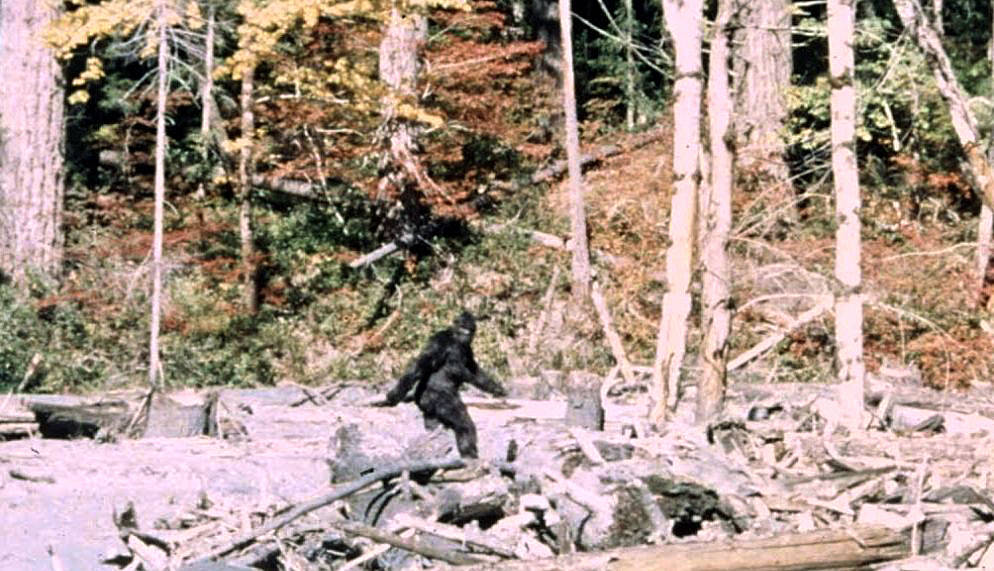
The seventies were a weird time. In the face of massive cultural upheaval, political radicalization, and institutional distrust, people were ready to believe pretty much anything. The world was a jaded, cynical place, and the American public were keen to look outside themselves and society for answers. Everyone wanted to feel like the world was bigger than they were, and wanted to imagine that there were places and things uncorrupted by human civilization. Audiences devoured speculation about UFOs, psychic phenomenon, the Bermuda Triangle, and … Bigfoot.
While sightings of a tall, anthropoidal biped in North America reputedly date back centuries, our modern concept of “Bigfoot” came from Bluff Creek, California in 1958. Loggers discovered strange footprints near their camp, and aptly – if uncreatively – christened the creature who made them “Big Foot,” a name shared with the world by local news reporter Betty Allen. In 1967, Roger Patterson and Robert Gimlin captured the first footage of the alleged cryptid while investigating the Bluff Creek area. Though analyzed with a level of scrutiny unheard of outside of the Zapruder film, a consensus regarding the veracity of the “Patterson-Gimlin” film has never been reached. Most of the scientific community ignored it. The media did not.
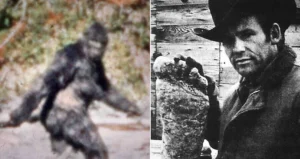
Roger Patterson (right) and the blurry star of his famed 1967 Bigfoot footage (left).
Patterson appeared on national television with the footage. Late night talk hosts including Johnny Carson, Merv Griffin, and Joey Bishop ran the film (and color commentary). Articles appeared in National Wildlife, Argosy, and dozens of newspapers around the country. The national, widespread publicity brought Bigfoot to the attention of millions: whether it was serious scientific interest or derisive skepticism didn’t matter, everyone had heard of Bigfoot. Sightings became more common, and given the newfound public interest, sightings were now news, keeping the creature in the public eye.
Hollywood, always making sure to strike while the iron is lukewarm, capitalized in 1970 with Bigfoot, a fly-by-night production starring John Carradine, whose presence itself should serve as a warning to cult film enthusiasts in the know. Regrettably, the stiflingly boring Bigfoot earns a place in horror history as the first ever feature film about the cryptid. Two years later, Bigfoot: Man or Beast? became the first documentary to explore the subject seriously. Well-made but poorly distributed, Man or Beast? failed to make much of an impact with audiences, becoming a footnote in comparison to another Bigfoot documentary made in Arkansas that same year.
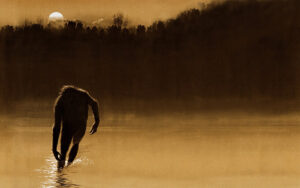
Star Wars concept artist Ralph McQuarrie lent his talents to The Legend of Boggy Creek’s striking poster.
Produced and directed independently by Arkansas filmmaker Charles B. Pierce, 1972’s The Legend of Boggy Creek was a massive success on the drive-in and grindhouse circuit, earning back millions against its minuet production budget (variously cited as somewhere between $150,000 and $200,000). The Legend of Boggy Creek had its roots in one of the myriad Bigfoot sightings reported in the wake of the Patterson-Gimlin film, a 1971 attack on a Fouke, Arkansas family by a Bigfoot-like creature.
In the wake of this attack by what the press dubbed the “Fouke Monster,” other eye-witnesses came forward with alleged sightings. Boggy Creek assembled these witnesses to retell their stories, presenting them alongside dramatized recreations of their encounters with the Fouke Monster. The film purports that sightings date back hundreds of years, though this is tough to verify: the apocryphal nature of cryptid sightings is their greatest boon and their greatest setback. They are difficult to prove, and equally difficult to outright disprove.
The Legend of Boggy Creek helped reignite public interest in the Bigfoot phenomenon, and its low-risk, high-reward production caught the attention of film and television producers. The documentary style of Boggy Creek reduced the need for actors, sets, and crew to a bare minimum, lowering its budget significantly: the threshold for profitability was low, and the return on investment was enormous. A slew of imitators emerged on the big and small screen.
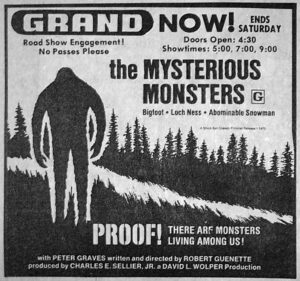
A newspaper ad for The Mysterious Monsters perhaps promises more than it can deliver.
The 1974 TV special Monsters! Mysteries or Myths? was one of the first Boggy Creek imitators, and is notable as one of the legendary Rod Serling’s last projects before his untimely 1975 death. Serling lends his voice, presence, and credibility to the documentary as its narrator, elevating it dramatically above much of its ilk.
Several theatrical films also adopted the pseudo-documentary style of Boggy Creek, beginning in 1975 with The Legend of Bigfoot and The Mysterious Monsters. Like Mysteries or Myths, Mysterious Monsters is distinguished by its narrator, a late-career Peter Graves. While Graves is significantly less invested in the material than Serling, the sight of him reading off of cue cards and daydreaming about firing his agent is worth seeing. Mysterious Monsters also distinguishes itself by adding segments on the other members of cryptozoology’s holy trinity, the Loch Ness Monster and the Abominable Snowman.
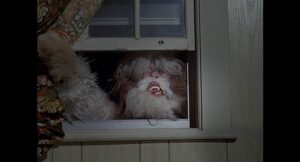
Shriek of the Mutilated wisely kept its murderous Bigfoot out of sight for much of its runtime.
A few narrative features released around the same time, including Creature from Black Lake and Sasquatch: The Legend of Bigfoot. They borrowed from Boggy Creek in their own way, keeping the creature obscured or off-screen, as Boggy Creek did in its dramatic recreation segments. 1974’s relentlessly sleazy Shriek of the Mutilated is the most notorious of the narrative Bigfoot films, and featured a homicidal maniac Bigfoot slaughtering college students in the woods. Shriek of the Mutilated is regarded in some quarters as one of the worst films ever made – an ignoble distinction it shares with several other Bigfoot films.
The problem faced by filmmakers seeking to tell a narrative story about Bigfoot was that they didn’t know what to do with their subject, oscillating between presenting Bigfoot as a terrifying monster and an awe-inspiring natural wonder. The most captivating thing about Bigfoot – the tantalizing fact that he could be real – was also a paralytic: it was the mystery of Bigfoot that held his allure. In portraying Bigfoot, a film runs the risk of demystifying him.
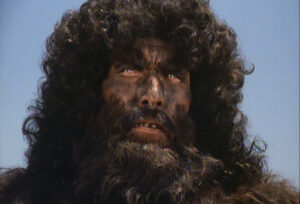
Ted Cassidy as the alien android Bigfoot in The Six Million Dollar Man episode “The Return of Bigfoot.”
1976 also kept Bigfoot to the small screen, through the Sid and Marty Kroft children’s program Bigfoot and Wildboy, and through the prime-time super-hero series The Six Million Dollar Man. The two part Six Million Dollar Man episode “The Secret of Bigfoot” saw cyborg and super-spy Steve Austin battle an alien robot modeled after Bigfoot, performed by actor and wrestler Andre Roussimoff (perhps better known by his stage name of “Andre the Giant”). A follow-up two parter came in the fall of 1976, replacing Andre with Ted Cassidy (Lurch of The Addams Family). A Kenner action figure of the Bionic Bigfoot became the hot Christmas item of 1976, and a board game would be released by Mego the following year. Earlier in the decade, model-kit manufacturer immortalized Bigfoot in plastic with a gnarly snap-together model featuring Bigfoot and a partial human skeleton.
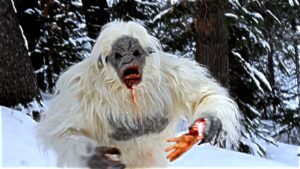
The Wampa-esque Snowbeast.
The craze would ebb in 1977 with some notable late-comers including a TV movie (Snowbeast), a fifth and final Six Million Dollar Man episode, and a Boggy Creek sequel (subject of a Mystery Science Theater 3000 episode). Leonard Nimoy would also weigh in on the mystery in his series In Search Of … featuring Bigfoot in several segments, and dedicating an episode to the cryptid in 1977. Bigfoot’s popularity fizzled, as with most fads of the mid-seventies, after the release of Star Wars. Spurred by Star Wars, audiences turned from exploring the mysteries of our planet’s past and present to the mysteries of space and the wonders of our future.
Bigfoot has lurked in the background of our pop cultural consciousness ever since. Though never hitting the epidemic proportions of the seventies, a steady stream of film and television – fiction and documentary – have continued to document and imagine encounters with the creature. In the endless quest to fill too-many channels of cable TV, Bigfoot and his cryptid cohort have become fodder for numerous series, including the long-running, Bigfoot-centric Finding Bigfoot.
A generation weened on these programs have led to a renewed interest in cryptids online, turning them into a popular subject for debate on online forums and social media. Information regarding these undiscovered creatures is readily accessible, sightings of them easily catalogued, and discussion is easy: if anyone, anyplace sees Bigfoot, it is an immediate matter of public record. The appeal is self-evident: the world has grown even smaller in the intervening decades, demonstrated by that self-same ease of access. If Bigfoot can hide in plain sight, it means there are still places we haven’t been, and maybe even a little wonder left in the world.








‘It Ends’ Final Trailer Takes Us on a Nightmarish Road Trip Into Existential Horror

‘Insidious 6’ Director Jacob Chase Returns to Blumhouse and Atomic Monster for New Horror ‘Sleepover’

‘The Institute’ Season 2 First Images Preview the Next Chapter of Stephen King’s Horror Series

New ‘Crystal Lake’ Image Teases Pamela Voorhees’ Descent Into Darkness

‘Black Mirror’ Season 8 Is Now in Production With New Episodes

‘Fall 2: Deadpoint’ Trailer Takes the Terror 5,000 Feet Above Thailand

Starting Small: The Independent Roots of Five of Horror’s Greatest Filmmakers

V/H/S (2012) and The Art of YouTube Horror

5 New Horror Movies Just Released to Watch at Home

‘Werwulf’ – Robert Eggers’ Haunting New Werewolf Poster Is Absolutely Stunning

‘Insidious: Out of the Further’ Opens With $25.3 Million at the U.S. Box Office

Ruth Wilson Is Terrifying in Creepy New ‘Family’ Trailer

‘Monster: The Lizzie Borden Story’ Trailer Unveils Sarah Paulson as Aileen Wuornos

‘P.T.’-Inspired Psychological Horror ‘T.W.I.R.L.’ Now Haunting Steam [Trailer]
