
Editorials
Murky Waters: A Brief Look at the Long Legacy of ‘Creature from the Black Lagoon’ Remakes

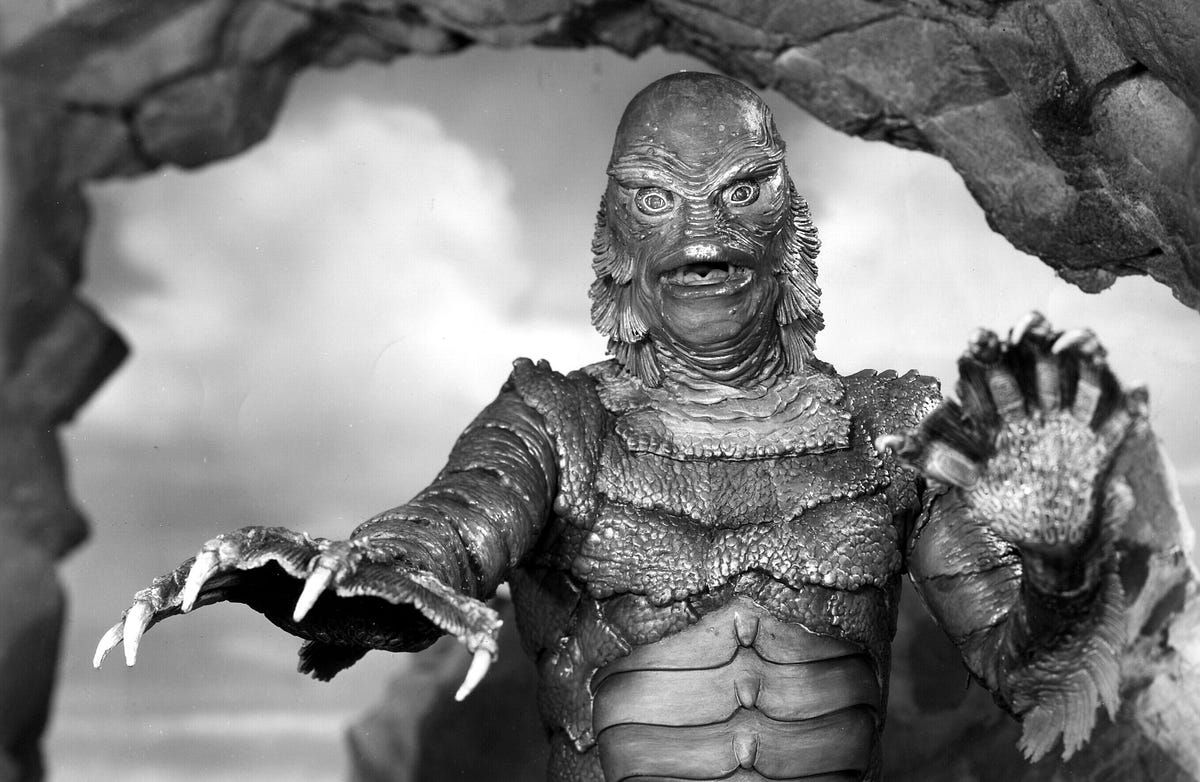
The year is 1941. William Alland is at a dinner party, drumming up money and interest in his friend Orson Welles’ first feature, Citizen Kane. If the way production was going was any indication, it will also be his last. To take his mind off of Welles’ disaster-in-the-making, Alland makes small talk with cinematographer Gabriel Figueroa. Somehow or another, the topic turns to a legend from Figueroa’s youth: the Yacuruna, a mythic race that live in sunken cities below the rippling waters of the Amazon River.
Though he spent the decades absorbed in other pursuits, Figueroa’s Yacuruna never left Alland’s mind, and in 1953, Alland wrote out the first treatment for a story then called The Sea Monster, drawing inspiration from his own youth, and the story of Beauty and the Beast. Working with writers Arthur Ross and Harry Essex, Alland’s Sea Monster would become Creature from the Black Lagoon, released on the American public in the winter of 1954.
An immense success for Universal-International, Creature from the Black Lagoon spawned two sequels, Revenge of the Creature and The Creature Walks Among Us. Even in Revenge, the point of diminishing returns was apparent: scenes and plot elements were retread from the first film, then repeated a third time in Walks Among Us. Coupled with reduced box office returns and cooling audience enthusiasm, Universal made the decision to retire the franchise.
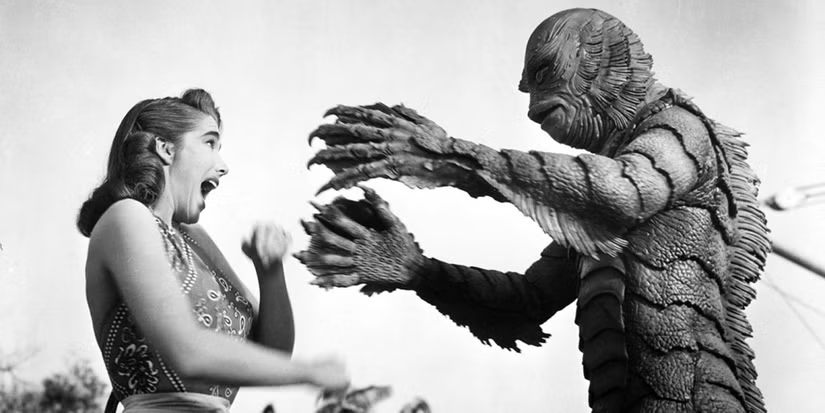
It was in 1981 that rumors began to swirl about a remake. The specific impetus for a remake is as murky as the Black Lagoon’s waters – save except for the seemingly uncontrollable urge studios possess to remake everything that ever made them money. Genre historian Tom Weaver notes that a remake was no great stretch of the imagination for Universal, already developing remakes of 1951’s The Thing from Another World and 1942’s Cat People. As initially conceived, the film was to be produced by John Landis (fresh off An American Werewolf in London), with a script by Nigel Kneale (scribe of Hammer’s Quatermass trilogy).
Kneale’s script amalgamated elements of all three of Universal’s previous Creature films: its first act saw the discovery and capture of the Gill-Man in the Amazon; its second would see him captive at an aquarium and experimented on by the government; its third followed him wreaking havoc through Long Beach. Perhaps the most intriguing element was the addition of a second monster, dubbed Homo Horribilis by Kneale. Described as “sort of a cross between a killer walrus and a sumo wrestler” by Tom Weaver in his behind-the-scenes book The Creature Chronicles, Homo Horribilis would have played a key role in the Gill-Man’s escape before being dispatched by the military. No concept art or pre-production work has ever emerged based on this script, which itself remains rare.
Developed as a potential vehicle for the early-eighties 3-D revival, Landis and Kneale’s Creature was discarded by Universal in favor of Jaws 3-D. The studio remained interested in a remake throughout the decade, though no solid progress was made until 1992, when John Carpenter would become attached to the project. Carpenter’s Creature from the Black Lagoon is perhaps the most famous incarnation of the proposed remake, owing to the tantalizing pre-production glimpses of the project which survive. Carpenter worked with the legendary Rick Baker to redesign the Gill-Man, and photos of Baker’s work have surfaced in the years since. Several drafts of Bill Phillips’ screenplay also survive, and are readily found on the internet. In his memoir Prince of Darkness, Carpenter states that he left the project due to disagreements with Universal over its budget.
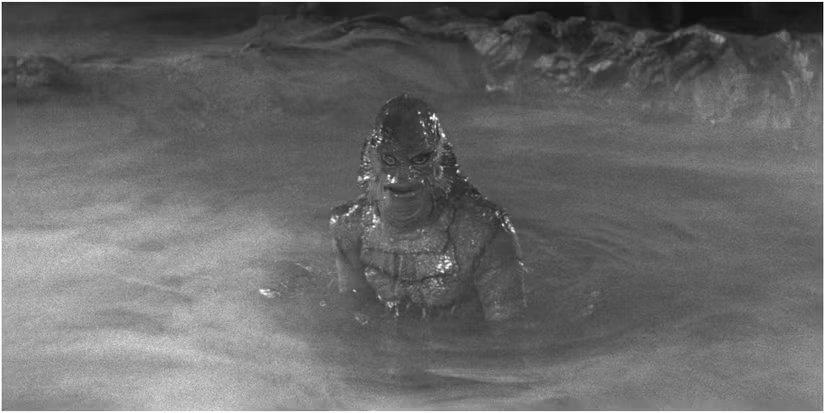
Ivan Reitman became attached after Carpenter’s exit, commissioning a new script by Timothy Harris and Herschel Weingrod. The duo were best known for comedies including Trading Places and Kindergarten Cop, making them a somewhat bizarre choice for Creature. The Harris and Weingrod script made drastic changes from the original, moving the action to a Floridian resort hotel, where renovations would uncover an egg of indeterminate vintage and origin that would then grow into the titular monster. Despite their background in comedy, Harris and Weingrod take their story in a dark, even grotesque direction. Their Gill-Man’s amorous designs for female lead Laura would be much more explicit than previous scripts, with the plot revolving around his efforts to mate with her.
Universal wisely passed on this iteration, but remained interested in a remake, next approaching Peter Jackson, who instead chose to move forward with a remake of King Kong. Following the success of 1999’s remake of The Mummy, Universal had a clear choice to remake Creature in Mummy writer/ director Steve Somers. Gary Ross (son of the 1954 original’s screenwriter, Arthur Ross) came on as a producer, eventually assuming additional duties as the film’s writer as well. Somers would delay Creature twice: first to make The Mummy Returns, then to make Van Helsing.
When the high-budgeted Van Helsing drastically underperformed, Universal removed Somers from Creature, tasking Ross with finding his replacement. Ross initially settled on Guillermo del Toro, though del Toro’s involvement was brief: Ross’s vision of a contemporary take on the material was ill-suited to del Toro’s “period Victorian” script, heavily inspired by Arthur Conan Doyle and Edgar Rice Burroughs. Del Toro imagined a lost civilization in the Black Lagoon, with the Gill-Man worshipped by natives as a Kong-like deity.
Some time around 2005, a script written by Ross himself would be used in another round of pre-production, first with Brett Ratner at the helm, and subsequently Breck Eisner. Ross’s version remained in development until at least 2008, when he would reference it as “actually moving forward” during a press conference. Ross described his film as taking the source material “seriously,” and was quick to create distance from a “campy, retro” approach. Ross elaborated that his film would not “wink at the audience or make it silly in any way,” perhaps with Van Helsing in mind as he said so.
Ross’s script focused on the improbably-named Carrie Bradshaw (apparently tiring of New York City and her endless will-they-won’t-they with Mister Big), an environmental activist. While exploring the Amazon, Carrie and her husband John become reluctant participants in a drug company’s mission to capture the Gill-Man for its vaguely-expounded on prospective medical uses. Kneale’s concept of a second creature re-emerges, this time taking the form of an adolescent offspring of the Gill-Man. The Junior Gill-Man would be captured by the expedition in the form of a lungfish, evolving over the course of the film into a man-fish. Eisner rewrote Ross’s script to be closer to a “PG-13 scary … dark adventure” in tone, and commissioned a redesign of the Gill-Man by Mark McCreery that emphasized his fish-like qualities.
Eisner departed from the project to instead remake George Romero’s The Crazies, and Ross bowed out of the project, joining a long and distinguished parade of producers. As with the previous three decades, work on a remake remained steady, with producer Marc Abraham commenting in a 2010 Bloody Disgusting interview that a “hipper” version of the story was being envisioned, and a writer sought who could deliver it. Abraham explained that this would be a “psychological transformation, [a] more literary transformation.” How these comments pertain to Creature from the Black Lagoon evades this author.
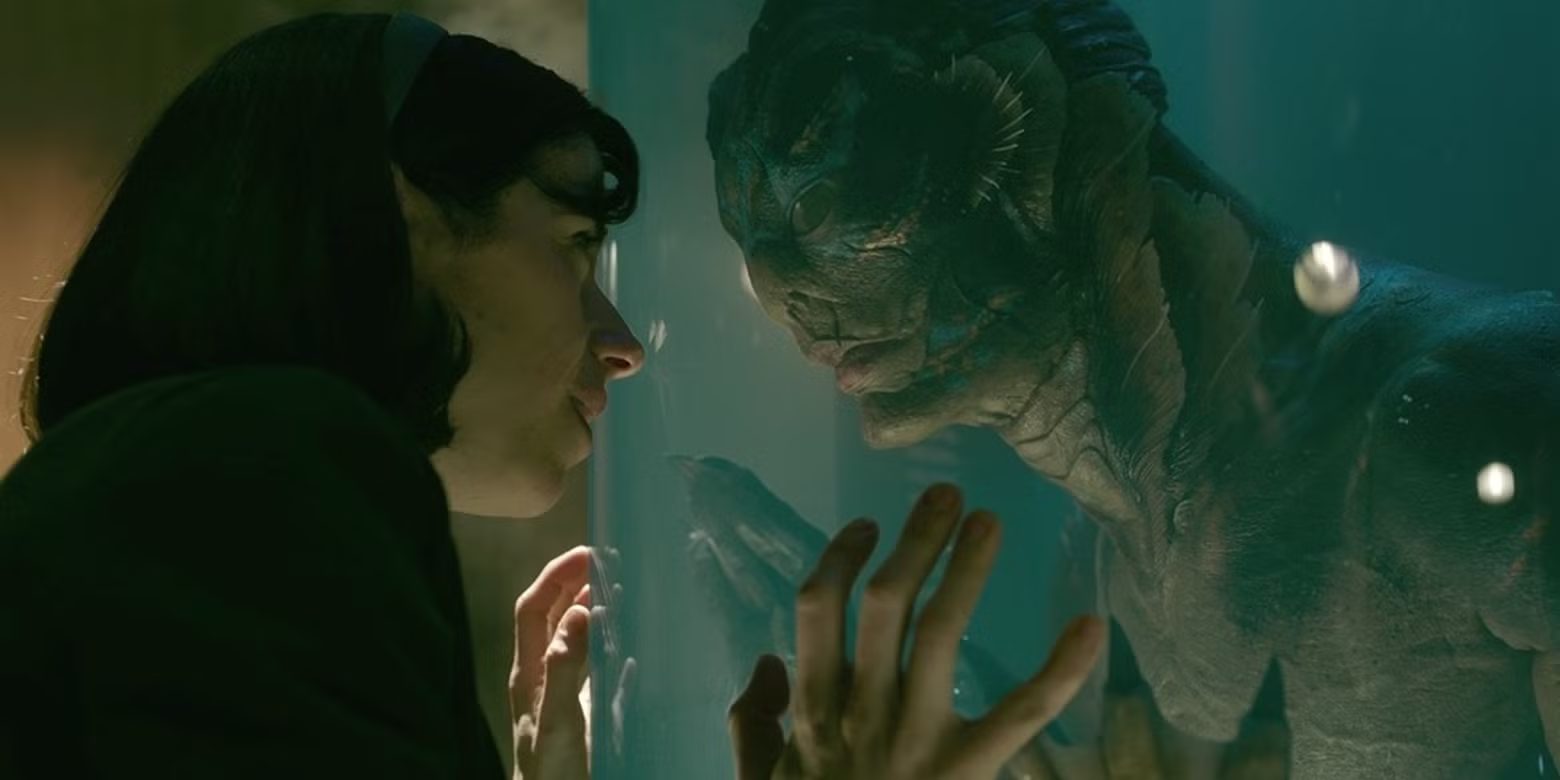
In 2017, Guillermo del Toro released The Shape of Water, to the general consensus that he had effectively remade Creature from the Black Lagoon. That same year, Universal would attempt to spark its “Dark Universe” of reimagined monsters with Alex Kurtzman’s The Mummy. A fossil Gill-Man hand would be seen in that film, one of its many optimistic teases of spin-off and sequel films that would never come. Little is known about the “Dark Universe” version of Creature, though Scarlett Johansson’s name was at one point tenuously attached. Most recently, in 2024, James Wan was announced to be working on the remake. No public-facing work has progressed on the film since, though it is still in development.
The decades of false starts and failures to launch beg the question of what, exactly, makes the original so difficult to reproduce. Five decades of horror’s luminaries have approached Creature from the Black Lagoon from every angle, and five decades of horror’s luminaries have been stymied. Earnest throwbacks, ground-up re-imaginings, and slick reinventions have been tried and retried, and have failed and failed alike. Perhaps the elusive, perfect script is out there, just at the tips of some writer’s fingers; or perhaps some things, like the opaque, concealing waters of the Black Lagoon, should be left alone, and what dwells there kept in its place as a relic, unable to be captured for the modern world.








5 New Horror Movies Just Released to Watch at Home

Stephen King’s ‘Desperation’ Is Coming to Life With a Horror Dream Team Behind the Camera

‘Ma 2’ Still in the Works as Producers Promise a Strong Script

‘V/H/S/MIXTAPE’ Premieres on Shudder This October

‘Werwulf’ – Robert Eggers’ Haunting New Werewolf Poster Is Absolutely Stunning

More than the Wolf Man: The Other Werewolves of Horror’s Golden Age

She Wakes Up Bound Inside a Car Trunk – Does She Deserve to Die?

‘Fall 2: Deadpoint’ Trailer Takes the Terror 5,000 Feet Above Thailand

A Mysterious Alien Force Invades in ‘Our Effed Up World’ Teaser

Exclusive ‘Hellcat’ Trailer Teases a Brutal Race Against Infection

Larry Fessenden Leads a Twisted Cult in Disturbing ‘Blood Shine’ Trailer
‘Fall 2: Deadpoint’ Trailer Takes the Terror 5,000 Feet Above Thailand

Josh Hartnett Faces a Deadly Sea Creature in ‘Below’ Teaser

Mike Flanagan’s ‘Carrie’ Teaser Introduces a New Nightmare
