
Editorials
Jaws-Mania: How The Biggest Horror Film of the 70s Inspired a Feeding Frenzy of Rip-Offs
Jaws (1975) became the first modern blockbuster—and Hollywood quickly learned how to copy it. The film sparked “Jaws-mania,” turning sharks into a cultural obsession and inspiring a wave of fear, merchandise, and even novelty hits.

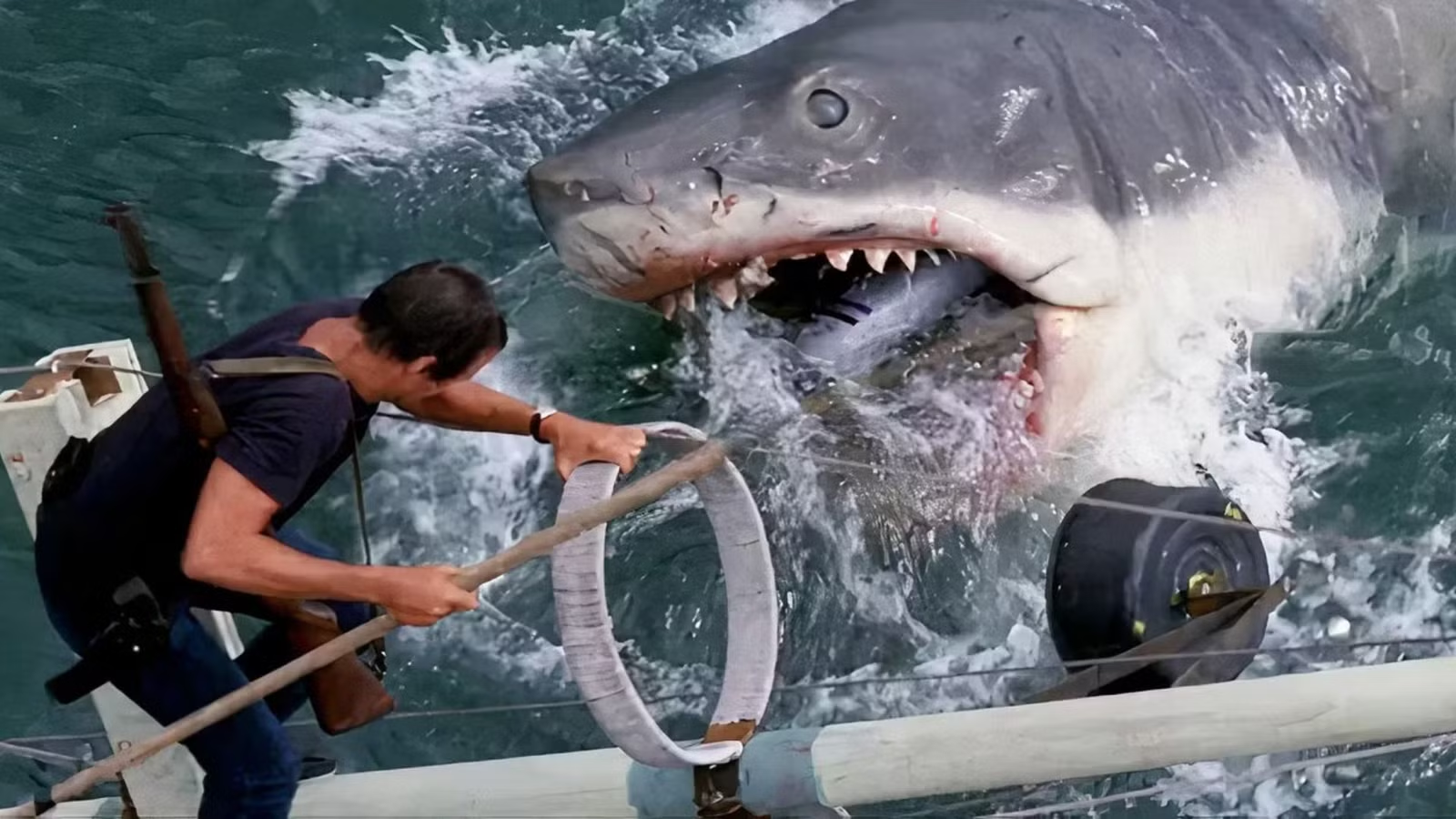
Not only does success have many fathers, it also spawns many imitators. Nowhere is this truer than in Hollywood, where the instant a film is successful, you can count on a half-dozen like it trying to ride its coat-tails. The practice is as old as the industry, though it was perfected in 1975 after the release of the film that crystalized Hollywood’s conception of the modern blockbuster: Jaws. Not only did Jaws change the way films were made, it changed the way they were ripped off, inspiring one of the most robust and bizarre catalogues of cash-ins, rip-offs, and knock-offs in its film history.
Jaws was far from a sure-thing for Universal even after its legendarily-troubled production. It was the first film to test a risky new release strategy, simultaneously coming to theaters nationwide on June 20th, 1975 (prior to Jaws, new releases were staggered across several weeks, opening in new regions one at a time). Universal launched nation-wide television advertising promoting the film, another industry first. For weeks before Jaws hit theaters, millions of viewers were being warned by voice-actor Percy Rodriguez that “none of men’s fantasies of evil can compare with the reality of … Jaws.” The risks paid off, Jaws made obscene amounts of money and became the pop culture sensation of the year, remaining number one at the domestic box office for three-and-a-half months.
So-called “Jaws-mania” went far beyond the movie theater: shark sightings dominated the evening news, merchandise filled store shelves, and millions of Americans were terrified of the water. A 1975 Gallup poll found that 47% of women and 23% of men surveyed were afraid to swim after seeing the film. Rubber sharks lined store shelves – some even emblazoned with packaging or a sticker declaring them “official” Jaws merchandise. Of course, once removed from the packaging or deprived of their sticker, an official Jaws shark looked no different than any other “Great White Shark.” Higher-effort merchandise, like Addar’s Jaws model kits and Ideal’s still-iconic Jaws game were ready in time for Christmas.
Even Marvel and DC Comics – who never met a trend they couldn’t chase – got in on the fun: in November of 1975, DC’s Superman faced the “Jaws of the Killer Shark,” while Marvel’s Ghost Rider battled a great white “in the gripping tradition of Jaws.”
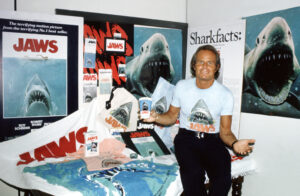
Jaws producer Richard Zanuck poses with some of the film’s merchandise.
Public interest was so strong that Dickie Goodman’s god-awful novelty song “Mister Jaws” managed to crack the billboard top five. This truly bizarre tune is structured as the singer conducting interviews with the film’s characters (Hooper, Quint, Brody, and the titular shark), captured through sound-bites from other popular songs in an early version of sampling. For those having a hard time envisioning this, an example would be Goodman asking “Jaws” “Mr. Jaws, before you swim out to sea, have you anything else to say?” followed by the refrain “Why can’t we be friends? Why can’t we be friends?” sampled from the War song of the same name. This charted higher than “Bohemian Rhapsody” in the United States.
While Jaws was still commanding lines around the block and “Mister Jaws” somehow dominated the airwaves, producer Harvey Flaxman and his family went camping. During the trip, Flaxman had an encounter with a bear that gave him the idea for a killer bear-centric horror film. Inundated with the current pop cultural omnipresence of Jaws, Flaxman and his business partner David Sheldon realized that it was the exact right time to make such a film, and didn’t waste a second: Grizzly was written, funded, and shot before 1975 came to a close. It arrived in theaters less than a year after Jaws’ June 1975 release.
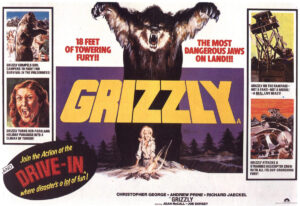
Grizzly promised more horror than audiences could bear (sorry, we had to do at least one).
Grizzly’s plot fills in the gaps from its rushed production by borrowing wholesale from its inspiration. The plot concerns a park ranger (Christopher George) and a naturalist (Andrew Prine) in pursuit of a killer grizzly bear loose in a national park, impeded by a park supervisor (Joe Dorsey) who refuses to shut the park down during its peak tourist season. Brody and Hooper recruit a crazed hunter with a personal vendetta against the grizzly to help them track it down. While lacking in originality, Grizzly’s engaging performances, tense direction (from the late, lamented William Girdler), and striking locations (shot in Clayton, Georgia) were a hit with a Jaws-frenzied audience. It grossed $38 million against a budget of $750,000; no doubt helped by comic book legend Neal Adams’ striking poster. This incredible return on investment spurred dozens of producers to follow its example.
Also released in 1976 was Mako: Jaws of Death, which also starred Richard Jaeckel. Mako was bold enough to just straight-up also be about a shark, and to use the word “jaws” in its title. More impressive is that it did this without earning the ire of Universal, notoriously litigious about these knock-off films. By the early eighties, they filed injunctions to block their release fairly routinely (several remain without an official U.S. release to this day).
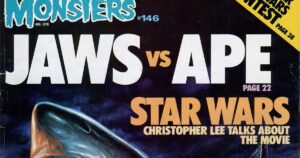
Famous Monsters of Filmland might be overselling A*P*E just slightly.
The strangest (and funniest) Jaws-inspired moment in 1976 cinema is from A*P*E, whose primary aim was – as the title might imply – to rip off Dino De Laurentiis’s remake of King Kong. In a wonderfully optimistic touch, A*P*E’s poster feels the need to clarify that it is “Not to be Confused with King Kong.” Allegedly the result of legal action, it has been suggested this was wishful thinking on the part of producer Jack H. Harris. Hastily thrown into this fly-by-night disaster was a scene where the titular ape wrestles with a shark, played by a real, dead shark carcass. Awe-inspiring in its ineptitude, the scene somehow earned immortality as the cover of a 1978 issue of Famous Monsters of Filmland, emblazoned with the eye-catching descriptor “JAWS VERSUS APE” in print as large as the magazine’s title.
These three were only the beginning: Grizzly set a template that, coupled with its box office returns, was practically a recipe for success. All enterprising producers needed were a deadly animal, a couple of slumming stars, and a few borrowed plot points. In the years that followed, the floodgates would open, sending a swarm of tentacles, claws, and even blades up from the depths. Just when you thought it was safe to go back in the water, Roger Corman is filming three other movies there.
The lead-up to 1978’s Jaws 2 saw the “Jawsploitation” rip-off phenomenon reach epidemic proportions, with major studios and independent producers the world over investing in killer animals and underwater horror. Japan’s Toei Studios would make their most expensive film to date with 1977’s Legend of Dinosaurs and Monster Birds; King Kong maestro De Laurentiis would enter the arena with two high-budget Jaws rip-offs, The White Buffalo and Orca: The Killer Whale. And while the box office records held by Jaws were shattered by Star Wars, giving filmmakers a new trend to chase, Jawsploitation endured. Like the TV spots that helped Jaws capture the public imagination told us, “none of men’s fantasies of evil can compare with the reality of … Jaws.” It’s the same reason Jaws kept millions off the beaches, even though rationally they knew there was nothing to fear. The fear of the unknown, that awe and terror at the vastness of nature, is primordial. As long as those fears remain part of the human psyche, Jaws will resonate. And if a producer is lucky, so will anything else that captures that spirit.









‘Werwulf’ – Robert Eggers’ Haunting New Werewolf Poster Is Absolutely Stunning

‘The Conjuring: First Communion’ Adds Three New Actors to Ed & Lorraine Warren Prequel

Madeline Brewer, Emory Cohen and Nicholas Alexander Chavez Join Parker Finn’s Horror Movie ‘Possession’

Larry Fessenden Leads a Twisted Cult in Disturbing ‘Blood Shine’ Trailer

Christopher Landon to Direct Horror Movie Adaptation of Grady Hendrix’s ‘The Final Girl Support Group’

More than the Wolf Man: The Other Werewolves of Horror’s Golden Age

She Wakes Up Bound Inside a Car Trunk – Does She Deserve to Die?

A Mysterious Alien Force Invades in ‘Our Effed Up World’ Teaser

Exclusive ‘Hellcat’ Trailer Teases a Brutal Race Against Infection

‘Her Private Hell’ Debuts Striking Official Poster Featuring Its Lead Stars
Larry Fessenden Leads a Twisted Cult in Disturbing ‘Blood Shine’ Trailer

‘Fall 2: Deadpoint’ Trailer Takes the Terror 5,000 Feet Above Thailand

Josh Hartnett Faces a Deadly Sea Creature in ‘Below’ Teaser

Mike Flanagan’s ‘Carrie’ Teaser Introduces a New Nightmare
