
Editorials
Starting Small: The Independent Roots of Five of Horror’s Greatest Filmmakers
Before they became horror legends, John Landis, Joe Dante, David Cronenberg, John Carpenter, and Tobe Hooper all started small. From shoestring productions to ambitious independent films, these early works revealed the distinctive styles, themes, and obsessions that would shape some of horror’s greatest careers.

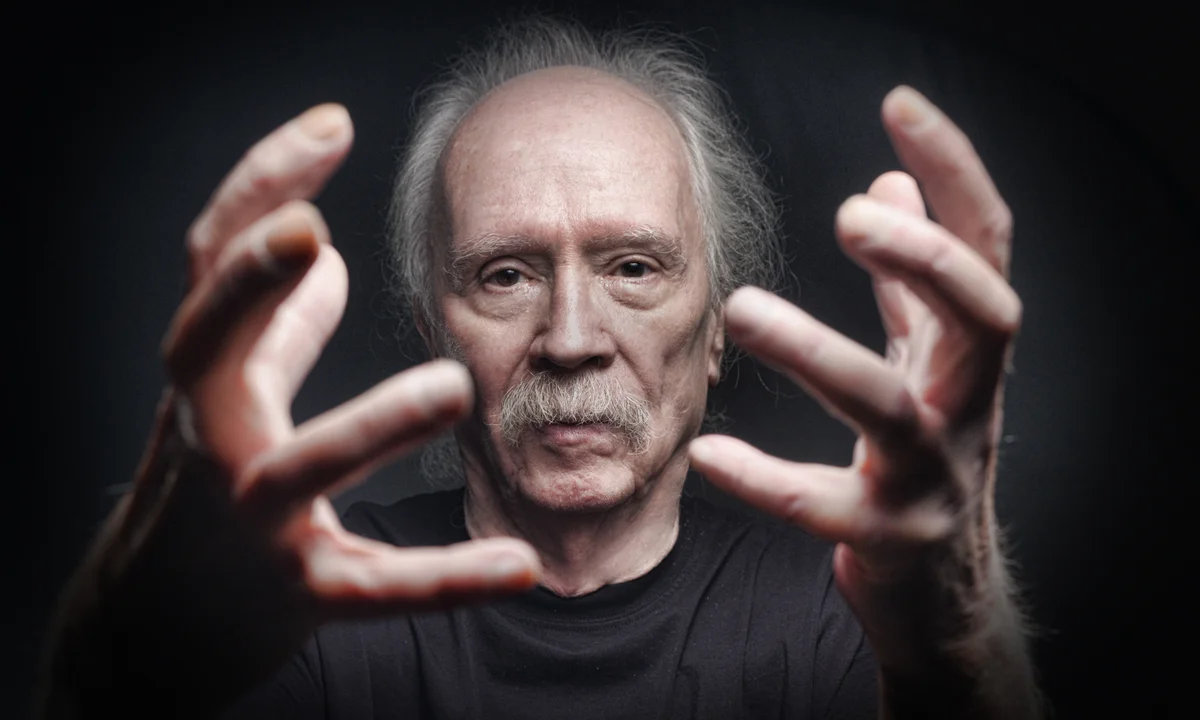
They say that everyone has to start somewhere, and for these five now-legendary directors, that meant the world of independent film. Since the nineteen-fifties, the structure of production and distribution pioneered by studios like American International Pictures has been the best way to circumvent the office politics of a major studio and get their work out into the world. What these early films lacked in budget and polish, they made up for in ingenuity and spirit, serving as a mission statement for the filmmaker’s career to come. By exploring these early works, you can see the traces of the ideas, themes, and fears that these visionaries would return to time and again.
5) Schlock (1973) – John Landis
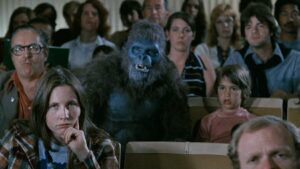
The star of 1973’s Schlock takes in a matinee of Dinosaurus! with Famous Monsters publishers Forest Ackerman (left).
One of the clearest examples of this phenomenon in action is John Landis’s directorial debut, Schlock. The plot is thin, following the monstrous missing link Schlockthropus as he emerges from his cave for the first time in eons and encounters the modern world. He goes to the movies, he crashes a party, he falls in love with Mindy (Eliza Garrett), naturally carrying her atop a building before being gunned down by the authorities. The suit was built by Rick Baker, who would go on to win an Oscar with Landis for his work on An American Werewolf in London.
Schlock is sporadically dull, meandering, and infectiously charming, displaying Landis’s aptitude for fish-out-of-water comedy as “Schlock” (for short) wanders the Hollywood Hills. It even features Landis’s signature See You Next Wednesday gag, a fake film advertised continuously through a string of incoherent ads and billboards. The film is also one of the first to feature a cameo by Famous Monsters of Filmland publisher Forest J. Ackerman, hero to a generation of “monster kids.” Ackerman would go on to be the Stan Lee of eighties horror, popping up everywhere from The Howling to Dead Alive to the “Thriller” music video.
Schlock’s very title evokes the kind of tongue-in-cheek, irreverent screwball comedy that would become the director’s forte, providing his An American Werewolf in London with its inimitable tone. An affectionate parody of fifties “monster on the loose” sci-fi horror, Schlock was one of the first films to codify a central motif of seventies and eighties horror: you could tell it was made with love. Landis’s jokes at the expense of movies like Monster on the Campus or King Kong are too specific not to have come from observation. That creative synthesis of what came before, facilitated by far too many late nights by the television, is exactly what makes the films of Landis and his contemporaries so great.
4) Piranha – Joe Dante
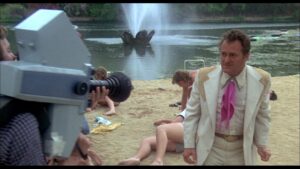
Long-time Joe Dante collaborator Dick Miller is front-and-center in a scenery-chewing role in Piranha.
The only appropriate way to follow up an entry about cheeky, self-aware horror is to discuss Joe Dante. I’ve discussed Piranha before in an article about the “Jawsploitation” phenomenon of the late seventies and early eighties, and it’s looking at Piranha in this context that makes it so remarkable. Literal dozens of Jaws knock-offs filled theaters in the late seventies and early eighties. Roger Corman, Piranha’s producer, was himself responsible for at least half-dozen. But none of them have the cult following that Piranha does, and certainly none have the stamp of approval of Jaws’ own director, Steven Spielberg. The difference was behind the camera, and it came from John Sayles’ script and Joe Dante’s direction. Piranha knows it’s ridiculous, but it wants you to have fun with it anyway. The film’s charm is that it’s in on the joke.
This is most visible in a favorite motif of Dante’s: the classic sci-fi and horror films that inform Dante’s storytelling and sensibility literally appear in his movies, playing in the background of key scenes. The director trademark is at its most effective in Dante’s follow-up film, 1981’s The Howling, in which a scene from 1941’s The Wolf Man is used to deliver key exposition. Here, it’s a startling, humorous scene transition with 1957’s The Monster that Challenged the World, a film whose influence is apparent throughout Sayles’ Piranha script. When it isn’t classic sci-fi and horror, it’s cartoons, a reminder of the prevailing Looney Tunes sensibility that gives Dante’s worlds their energy and off-beat scenarios. In Piranha, it’s Heather Menzies escaping from a prison cell by whacking the guard with a toilet tank cover.
Dante had previously worked as an editor and co-director on his friend Allan Arkush’s film Hollywood Boulevard in 1976. Together with Piranha, the two films established another beloved facet of Dante’s work: a stable of recurring bit actors Dante would describe as “the Joe Dante players,” mixing fifties sci-fi stars (Kenneth Tobey, Kevin McCarthy) with Dante’s friends (Belinda Belaski) and Corman favorites (Paul Bartel, Dick Miller). As mentioned, Piranha and Hollywood Boulevard were also made under the mercurial Roger Corman, who would take a chance on virtually any first-time director, though with the caveat that at any given moment, funds might vanish – as was the case on Piranha, where Dante suddenly found himself working with half the money he and Corman agreed on. The film was finished, turned a profit, and gave Dante the experience to guide films through writers’ strikes (The ‘Burbs), post-production headaches (Gremlins 2: The New Batch), and major legal trouble (Twilight Zone: The Movie).
3) Shivers – David Cronenberg
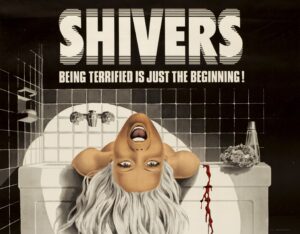
Shivers’ striking poster depicts a scene that would go on to inspire James Gunn’s Slither.
Canada’s booming independent film scene in the nineteen-seventies helped birth horror subgenres, first with 1974’s Black Christmas, then again the next year with David Cronenberg’s Shivers. Before Shivers, Cronenberg was a struggling director whose only feature credits were a pair of cerebral science fiction films that came and went from regional theaters without fanfare. Things changed when Cronenberg met a producer and fellow member of the Toronto Film Co-Op named Ivan Reitman (later of Ghostbusters, Stripes). Partnering with Reitman, Cronenberg took advantage of Canada’s then-generous government independent film funding grants – and hoped that no one would look too closely at the script for Shivers, his first foray into the horror genre.
For Shivers, Cronenberg turned horror inward in a way that few filmmakers had before, save for John Frankenheimer’s Seconds or Val Guest’s The Quatermass Xperiment. Few directors demonstrate as specific of a predilection for a subject matter as Cronenberg does for body horror – how many other directors’ names are literally synonymous with their visuals. Shivers is a grotesque, corporeal film that absolutely obsesses over the human form. Cronenberg is able to have his cake and eat it too: Shivers manages to simultaneously be thought-provoking and a grimy, sleazy exploitation film. Cronenberg’s producers and distributors got the film they paid for, and Cronenberg got to make a film that asks you why putting such a microscope on the human body repulses you.
Shivers serves as a mission statement for Cronenberg, embarking on a decades-long tightrope walk between art and exploitation. The film’s initial reception was, to put it mildly, polarizing, simultaneously becoming the highest grossing Canadian film ever made and the most controversial. Some critics, like Roger Ebert, were pleasantly surprised with Shivers’ intricacy and social commentary. Others couldn’t get past the violence, which sparked outrage and even backlash over Canada’s entire independent film grant system. These discussions carried all the way into the Canadian Parliament, though they did not lead to any significant change in legislature. Cronenberg’s own life was briefly made a living hell, with the director citing the controversy over Shivers as a major roadblock in funding his next several films. Apocryphally, Cronenberg’s landlord also evicted him over the film, citing a “morality clause” in the rent agreement.
2) Dark Star – John Carpenter
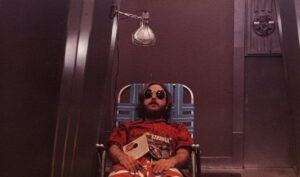
Dan O’Bannon sleep-walks through his performance in Dark Star. Note the Doctor Strange comic book.
Like Piranha, Dark Star is a two-in-one. It not only marks the feature directorial debut of John Carpenter, but the first feature screenplay of Dan O’Bannon. And it’s even more of a Dan O’Bannon film than it is John Carpenter. Dark Star’s pulp sci-fi tinted depiction of a blue collar interstellar travel is right in line with O’Bannon’s script for Alien, its idiosyncratic sense of humor anticipating his later script for Return of the Living Dead. John Carpenter’s trademark world-weary cynicism (even at twenty-five) is a perfect match for O’Bannon’s tedious, workaday future – the crew of the Dark Star and the men at Outpost #31 have a lot of common ground to commiserate over. Watching the film can also be a listless, tedious experience, thanks to another hallmark of Carpenter’s career: bad luck.
From its beginnings as a student film at the University of Southern California, Dark Star had a more than four-year journey to its theatrical premiere in December of 1974. It took Carpenter and O’Bannon two years to complete the initial, forty-five minute student film cut, and another year to find funding to expand it into a feature film. And then another year to find distribution, with the film’s distributor, Jack H. Harris (also distributor of Schlock), insisted on cutting a half hour of the film and reshooting it. As Dan O’Bannon puts it, Harris turned Dark Star from “the world’s most impressive student film” into “the world’s least impressive professional film.” Audiences ignored it, critics largely did the same. Those who did were unimpressed.
Dark Star turned a profit, enough for Carpenter to scrape by into funding his next film, Assault on Precinct 13. In decades since, Dark Star had been re-evaluated as a cult classic, setting the standard for most of Carpenter’s career: a drawn-out, painful production process, followed by critical lambasting and box office disappointment, followed by a gradual re-evaluation that sees the film hailed as a classic. It’s probably Carpenter’s pre-natural cynicism that gave him such patience with this cycle – even if he did have to day-drink his way through writing Halloween II.
1) The Texas Chainsaw Massacre – Tobe Hooper
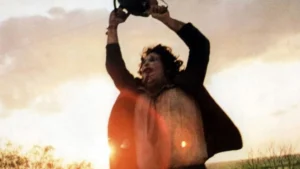
The closing scene of The Texas Chainsaw Massacre earns its reputation as one of the most striking visuals in horror history.
Taking into account what he had to work with, Tobe Hooper’s The Texas Chainsaw Massacre is probably the single most impressive independent film ever made. Yes, the pacing is sometimes a little leaden. Yes, the characters aren’t especially interesting. But for a sixty-thousand dollar production budget (plus an extra eighty-thousand for post-production), Hooper’s film can legitimately make a viewer break a sweat. Shot on 16mm film during grueling, sixteen hour days, The Texas Chainsaw Massacre’s greatest asset is Hooper’s nerve-wracking ability to create tension just through a sense of place – hard-earned by Hooper’s background as a documentary cameraman.
The suffocating dead heat of a Texan summer swelters off the screen, the impassive eye of Hooper’s camera makes everything feel uncomfortably, unflinchingly real. The film’s most frightening moments aren’t the spectacular bursts of violence when Gunnar Hansen’s Leatherface is on-screen, it’s the skin-crawling build-up of dread that they punctuate. By necessity of budget, very little is able to happen in The Texas Chainsaw Massacre, something that’s endemic of most of the films on this list, but through emphasizing great art direction and sound design, Hooper turns that into a virtue. It’s the rare directorial debut that is widely agreed to go unsurpassed by anything that follows.
Like his contemporaries on this list, Hooper is able to synthesize his own influences (in this case, Todd Browning, whose refined sense of the grotesque oozes off of Hooper’s own production design) with his passion for the medium and contemporary anxieties to create a startling nightmare vision. Far more than what they delivered, these films were remarkable for what they promised: new voices whose vibrant imaginations would elevate the horror genre to some of its greatest artistic and financial heights.








V/H/S (2012) and The Art of YouTube Horror

Starting Small: The Independent Roots of Five of Horror’s Greatest Filmmakers

A New ‘Leprechaun’ Movie Is in the Works at Lionsgate

5 New Horror Movies Just Released to Watch at Home

Stephen King’s ‘Desperation’ Is Coming to Life With a Horror Dream Team Behind the Camera

More than the Wolf Man: The Other Werewolves of Horror’s Golden Age

‘Fall 2: Deadpoint’ Trailer Takes the Terror 5,000 Feet Above Thailand

She Wakes Up Bound Inside a Car Trunk – Does She Deserve to Die?

‘Werwulf’ – Robert Eggers’ Haunting New Werewolf Poster Is Absolutely Stunning

A Mysterious Alien Force Invades in ‘Our Effed Up World’ Teaser

Larry Fessenden Leads a Twisted Cult in Disturbing ‘Blood Shine’ Trailer
‘Fall 2: Deadpoint’ Trailer Takes the Terror 5,000 Feet Above Thailand

Josh Hartnett Faces a Deadly Sea Creature in ‘Below’ Teaser

Mike Flanagan’s ‘Carrie’ Teaser Introduces a New Nightmare
