
Editorials
Jaws-Mania 2: A Look Back at the Jawsploitation Films of 1977 and ’78
Just when you thought it was safe to go back in the water, film studios filled the land, sea, and sky with “Jaws” inspired horrors ahead of 1978’s “Jaws 2.”

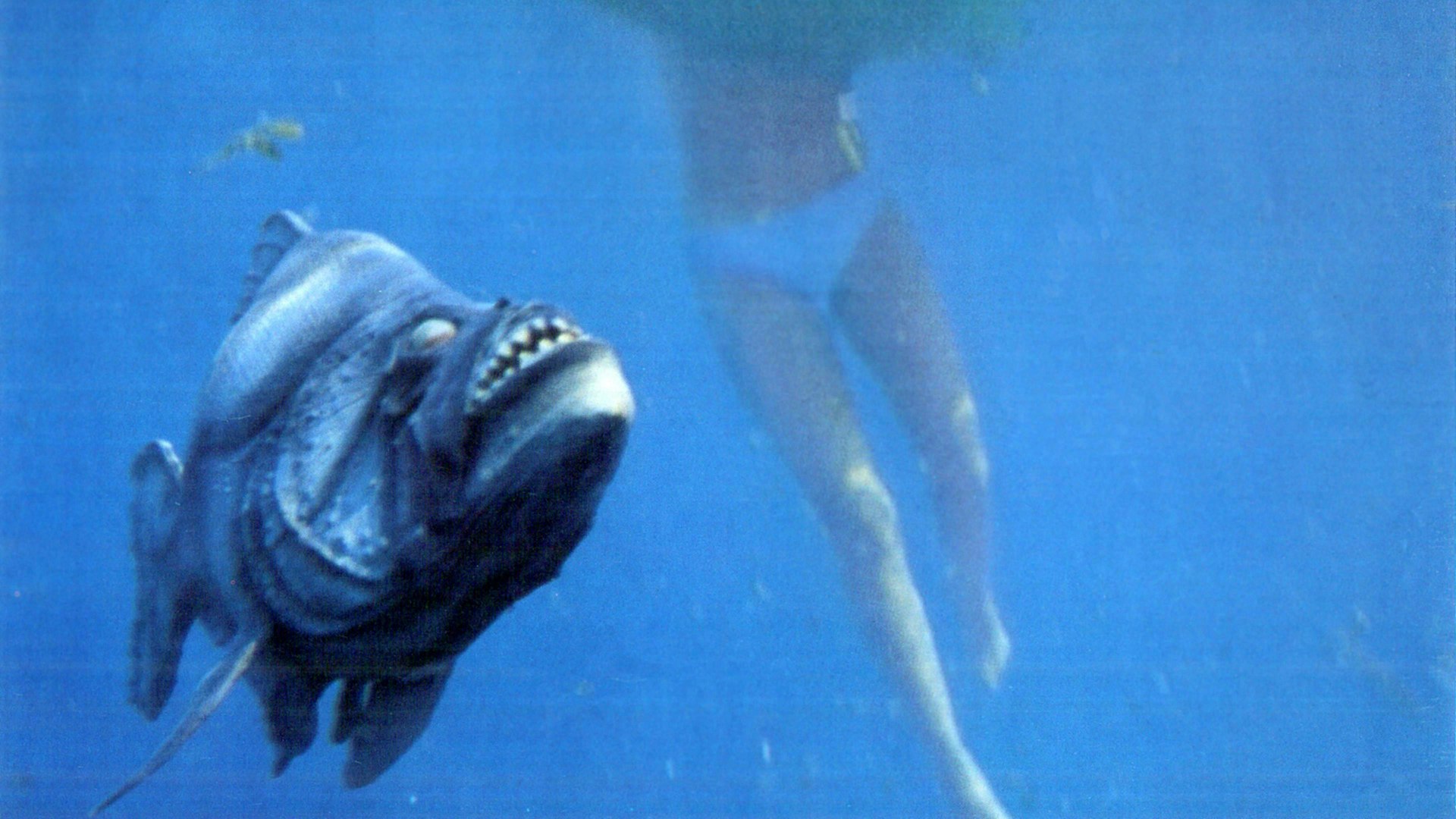
Last week, we saw how Jaws not only broke box office records, but changed the film industry doing it. The film’s bold, high-risk marketing and release strategies catapulted it to its status as the highest-grossing film ever made, and ensured that an estimated one in three people had either seen it or planned to. Beyond the box office, Jaws was a cultural phenomenon, inspiring fear and fascination with sharks, the underwater world, and nature’s greatest predators. A few fast-working independent producers were ready with the first wave of Jaws knock-offs by the following year, with Grizzly holding a crown of its own as the biggest independent film of 1976. By the following year, major studios and independent producers the world over were ready to release their attempts to capitalize on Jaws; making 1977’s Jawsploitation explosion the single largest volume of rip-off movies released in a single calendar year.
Any true cult film fan will tell you that the Italian film industry are the undisputed masters of rip-off fare. Their Dawn of the Dead rip-offs and Mad Max-inspired post apocalypse films became genres in and of themselves, and Italy was the single largest international producer of Jawsploitation. That began in 1977 with Tentacles, a killer octopus film co-produced by American International Pictures (AIP), the kings of American rip-off cinema. Director Ovidio Assonitis alleges that no less than John Wayne had originally agreed to star in Tentacles, but had to drop out of the project on account of his failing health. The part intended for Wayne instead went to Henry Fonda, alongside a baffling grab-bag of celebrities including John Huston, Shelley Winters, Bo Hopkins, and Claude Akins. The opening credits of Tentacles read like the beginning of a Love Boat episode. Assonitis also mentions that the script for Tentacles began life as a comedic send-up of Jaws, but was retooled into a serious film at the behest of AIP’s Samuel Z. Arkoff.
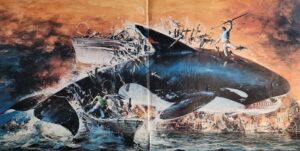
John Berkey’s eye-catching poster for Orca: The Killer Whale graced the back of many a comic book in the summer of 1977.
Two of 1977’s most prominent Jaws rip-offs came from legendary Italian producer Dino DiLaurentiis, who took a subtle approach with The White Buffalo and an obvious one with Orca: The Killer Whale. Orca screenwriter Luciano Vincenzoni was awakened one night in 1975 by a phone call from DiLaurentiis, who instructed him to “find a fish tougher and more terrible than the great white.” The result was an ecologically-minded revenge story in the vein of Moby Dick, with an inebriated and belligerent Richard Harris pursued from Newfoundland to the arctic circle by the titular killer whale after Harris kills its mate and calf. Harris was self-medicating in the face of his failing marriage to model Ann Turkel (later the star of 1981 Jawsploitation film Humanoids from the Deep), and was reportedly nearly killed on several occasions while drunkenly insisting on performing his own stunts.
Already in early production when Jaws hit, Charles Bronson vehicle The White Buffalo saw Jaws-inspired modifications to its script and antagonist, though the story remained largely a character study grounded in Bronson’s portrayal of Wild Bill Hickok and Will Sampson’s Crazy Horse. A Jaws western, The White Buffalo was one of two major 1977 releases to combine Jaws with other popular genres. Universal’s The Car paired a sentient, killer George Barris-designed Oldsmobile with Hal Needham-like stunts and a vague dash of post-Exorcist Satanic panic. While the antagonist is original (predating Stephen King’s better-known killer car Christine by some six years), James Brolin’s small town sheriff is one of the most direct Sheriff Brody analogues in the Jawsploitation canon.
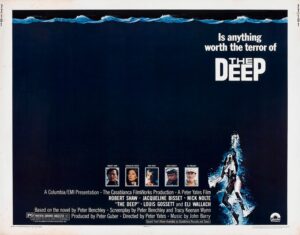
The empty space on this poster reminds us that Columbia wasn’t concerned with whether audiences knew what The Deep was about.
Columbia’s The Deep had virtually nothing to do with Jaws – but one could certainly be forgiven for misappraising this, given that the studio built its marketing campaign around water and Peter Benchley (and Jacqueline Bisset). Warner Brothers’ contender was The Pack, which was less immediately Jaws-inspired, since it owes a greater debt to earlier “nature’s revenge” films. A consequence of the decade’s newfound environmental-consciousness, the “nature’s revenge” subgenre predates Jaws with films like 1972’s Frogs and Night of the Lepus, though the volume produced increased conspicuously post-Jaws.
The Pack suffers from a key, glaring problem, shared by Night of the Lepus and its killer bunny rabbits: the antagonists are dogs. Dogs aren’t scary, and people are predisposed to squirm when they see dogs hurt, even when they’re “the bad guys.” The Pack’s “nature’s revenge” film peer Day of the Animals hypothetically fares better, in that it features legitimately-threatening antagonists like bears and mountain lions, but loses any real credibility when star Leslie Nielsen gets shirtless and wrestles a bear.
The underwhelming star of Toei’s Legend of Dinosaurs and Monster Birds.
Toei’s Legend of Dinosaurs and Monster Birds came to Japanese theaters in 1977, but had been greenlit before Jaws even arrived in Japanese theaters in December of 1975. Toei president Shigeru Okada screened Jaws shortly after the film’s U.S. release, and was certain the film would be a hit with Japanese audiences, commissioning Toei to develop their own Jaws. The production was budgeted as the most expensive in the studio’s history, and the expense was justified when Jaws became the highest grossing American film of all time at the Japanese box office (grossing almost Ɏ12 billion). Though moody and well-shot, Toei’s decision not to invest more of their budget into the film’s special effects is to its detriment, with neither of the stiff, rubbery titular monsters feeling properly menacing. For any curious about seeing the film, YouTuber Brandon Tenold can save you some time.
Ironically, given that the film is liberal in lifting entire scenes from Jaws, Legend of Dinosaurs and Monster Birds does not follow Jaws’ example of hiding unconvincing special effects. The Crater Lake Monster adopts this model to a fault, with the film’s hasty editing process leaving much of the only worthwhile thing about it on the cutting room floor. Scenes of a beautifully-realized stop motion plesiosaur brought to life by Dave Allen and Phil Tippett (whose other 1977 credit was Star Wars) are sacrificing in favor of meandering establishing shots and long arguments between two secondary characters about their boat rental business.
¡Tintorera! is a dizzying collision of grindhouse tropes in a Jawsploitation wrapper, boasting a runtime longer than Jaws itself in its uncut form. From Mexican exploitation maven Rene Cardona Jr, ¡Tintorera! and its two hour and six minute runtime are packed to the gills with sex, drugs, heavy drinking, murder, and real-life animal cruelty. To give you an idea just how much debauchery is packed in, the film was cut down by more than forty minutes to appease several international censors. A less demented grindhouse Jaws rip-off is Claws, most notable for its admirably direct title. Also featuring a killer grizzly on the rampage in a tourist-infested campground, Claws becomes a rip-off of a rip-off as it virtually remakes Grizzly.
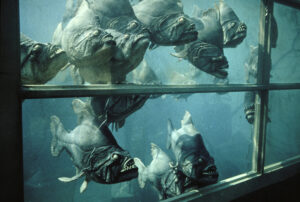
The stars of Joe Dante’s Piranha drop in for a bite.
1978 saw the volume of Jaws rip-offs drop precipitously as Universal prepared to release its official Jaws sequel that summer. Undaunted by the prospect of competing with the real thing, exploitation cinema legend Roger Corman at last entered the Jawsploitation arena with Piranha, arguably the best regarded of the Jaws imitators (including Jaws 2). Like many of Corman’s films, Piranha launched the careers of several of its key behind-the-camera talent, serving as a breakout success for director Joe Dante and screenwriter John Sayles. The pair have Steven Spielberg to thank, as Universal intended to file an injunction against Piranha to prevent its release. Universal cited Piranha’s premise as too similar to Jaws, especially given its proximity to Jaws 2’s release. Spielberg saw an early screening of Piranha and was impressed enough with its wit and creativity to talk Universal out of it. The film even led to a lasting friendship between Spielberg and Dante, who collaborated on 1983’s ill-fated Twilight Zone: The Movie.
Curiously, Universal seemed unbothered by 1978’s Barracuda, which cribbed just as liberally from Jaws as Piranha. Piranha marked a change in attitude from Universal in the lead-up to Jaws 2, which also took a bite out of Orca. In a key scene, a dead orca washes up on the shore of Amity Island, a bite taken out of its by Jaws 2’s bigger, badder great white shark. This would set the pace going forward: Jawsploitation films would have to get a lot more original, or at least a lot less obvious, to make it past the ever-warier eyes of Universal’s legal team.
As the seventies became the eighties, Jawsploitation would be taken in strange new directions – although perhaps no stranger than the approach Universal took to its latter two Jaws sequels. Nevertheless, the lasting popularity of Jaws was too strong a lure to horror producers in the video store decade to ignore. Jawsploitation remained prevalent, though lurking just beneath the surface, haunting video store aisles and late night cable listings. As long as Jaws endures, so will Jawsploitation.








5 New Horror Movies Just Released to Watch at Home

Stephen King’s ‘Desperation’ Is Coming to Life With a Horror Dream Team Behind the Camera

‘Ma 2’ Still in the Works as Producers Promise a Strong Script

‘V/H/S/MIXTAPE’ Premieres on Shudder This October

‘Werwulf’ – Robert Eggers’ Haunting New Werewolf Poster Is Absolutely Stunning

More than the Wolf Man: The Other Werewolves of Horror’s Golden Age

‘Fall 2: Deadpoint’ Trailer Takes the Terror 5,000 Feet Above Thailand

She Wakes Up Bound Inside a Car Trunk – Does She Deserve to Die?
‘Werwulf’ – Robert Eggers’ Haunting New Werewolf Poster Is Absolutely Stunning

A Mysterious Alien Force Invades in ‘Our Effed Up World’ Teaser

Larry Fessenden Leads a Twisted Cult in Disturbing ‘Blood Shine’ Trailer
‘Fall 2: Deadpoint’ Trailer Takes the Terror 5,000 Feet Above Thailand

Josh Hartnett Faces a Deadly Sea Creature in ‘Below’ Teaser

Mike Flanagan’s ‘Carrie’ Teaser Introduces a New Nightmare
