
Editorials
Pulse-Pounders: Charles Band’s Lost and Found Cult Classic
Pulse-Pounders was shot in 1987 and 1988 with a 1988 release date in mind. Instead, it has yet to be seen in its complete form to this day.

Every fan of eighties and nineties horror knows the name Charles Band, seen at the start or the end of literally hundreds of films’ opening credits. In terms of output, Band has few peers, his CV only really comparable to the likes of Samuel Z. Arkoff or Roger Corman. During the brief lifetime of Band’s Empire Pictures, he spawned some of the greatest video store cult classics of the eighties, including genre-bending sci-fi fantasy (The Dungeonmaster), sci-fi noir (Trancers), and classic adaptations of H.P. Lovecraft (Re-Animator, From Beyond). With the legacy and impact of Empire Pictures looming so large, it’s remarkable that the final film it produced remains obscure even to die-hard fans of the studio: 1988’s Pulse-Pounders.
Envisioned as an anthology film, Pulse-Pounders’ three segments were to have been comprised of sequels to Trancers and The Dungeonmaster, and a Lovecraft adaptation with Re-Animator and From Beyond’s Jeffrey Combs and Barbara Crampton. The never-finished Pulse-Pounders is one of the most tantalizing “what-if”’s in horror history, with a fascinating journey from its production to its decades-later rediscovery and partial release.

A sign of quality: the Empire Pictures logo from its 1983 inception to its 1988 demise.
Pulse-Pounders was shot in 1987 and 1988 with a 1988 release date in mind. Instead, it has yet to be seen in its complete form to this day, collateral damage in one of the most-consequential and least-talked about chapters of Hollywood history: the decline of Empire Pictures’ chief creditor, French bank Credit Lyonnais. As part of an aggressive portfolio diversification effort, Credit Lyonnais became the premier financier of American independent film in the 1980s, with its robust list of clients included Empire, Carolco, Vestron, and other now-bankrupt studios.
Books could be written on Credit Lyonnais’ involvement in Hollywood and its impact, but what concerned Band and Empire was their sudden and sharp decline. The bank’s dubious lending practices and investment strategies came to roost in the late eighties and early nineties, drawing scrutiny from shareholders and federal law enforcement alike, and causing them to tighten the purse-strings on their debtors. After aggressively expanding their production and distribution capabilities with money borrowed from Credit Lyonnais 1987, Empire defaulted the following year on the twenty-six million dollars they subsequently owed. Empire Pictures and its catalogue were absorbed by Credit Lyonnais subsidiary Epic Productions, leaving several complete-but-unreleased projects in legal limbo.
While several (Arena, Robot Jox) saw eventual release under Band’s new Full Moon Features production company, Pulse-Pounders remained on the shelf indefinitely, and at some point, Band lost track of the film. Considered lost for twenty-five years, a VHS workprint of Pulse-Pounders was discovered in 2011, allegedly while Full Moon was moving offices. The fate of the 35mm negative that this VHS print was transferred from is unknown, though it is likely lost. Full Moon set to work restoring its three segments for release, though as of 2026, only the Lovecraft-inspired “The Evil Clergyman” and the Trancers sequel segment have been made available. The fate of The Dungeonmaster segment is unknown: despite a press release from Full Moon stating this segment had been “shot and edited,” it remains unreleased.
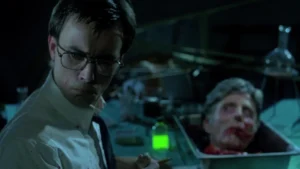
Jeffrey Combs in the title role of Empire’s Re-Animator. The severed head belongs to Combs’ Evil Clergyman co-star David Gale.
The first segment to see the light of day was “The Evil Clergyman,” which premiered at 2012’s Flashback Weekend horror convention in Chicago. Full Moon would release the segment on DVD the following year. “The Evil Clergyman” has a backstory as strange as Pulse-Pounders: though it purports to be “based on a short story by H.P. Lovecraft,” the short story in question was in fact adapted from a letter Lovecraft wrote to Bernard Austin Dwyer. Published posthumously by Weird Tales in 1939, “The Wicked Clergyman” was an excerpt from Lovecraft’s letter to Dwyer in which Lovecraft described a strange dream he had.
Despite being a take-off of Band-produced Re-Animator and From Beyond, even reuniting cast members from both films, The Evil Clergyman lacks the participation of their co-producer Brian Yuzna and director Stuart Gordon. The Evil Clergyman follows a woman (Barbara Crampton) compelled to visit the haunted home of her recently-deceased lover, the titular evil clergyman (Jeffrey Combs). The segment also features brief (but welcome) appearances by David Warner as a bishop assigned to excommunicate Combs and David Gale (Re-Animator). Gale’s role is bizarre, appearing briefly as a rat-faced nightmare creature that attacks Crampton in her sleep. It is somehow only the second worst thing Gale has done to Crampton in a film. Reviews were favorable, though not at par with Empire’s other Lovecraft adaptations.

Poster art for the original 1984 Trancers, starring Tim Thomerson.
Following The Evil Clergyman, the Trancers segment premiered at 2013’s Flashback Weekend convention. Released as Trancers: City of Lost Angels, a DVD and Blu Ray release would follow in the fall of that year. Shot in ten days at Empire’s production facilities in Rome (whose construction were a key factor in its financial troubles), City of Lost Angels is the first direct sequel to 1984’s Trancers, billed today as by Full Moon as Trancers 1 ½. In it, time-displaced detective Jack Deth (Tim Thomerson) defends himself against a vengeful time-traveling assassin, hellbent on paying Deth back for sending her to jail. Though complete, City of Lost Angels is less polished than The Evil Clergyman, lacking a finished sound mix: its soundtrack is lifted directly from the original Trancers, deepening the mystery of just how finished Pulse-Pounders was. This fuels speculation that filming for the final segment, The Dungeonmaster II: A Sorcerer’s Nightmare, was never completed.
With the release of The Evil Clergyman and City of Lost Angels, the assumption was that A Sorcerer’s Nightmare would follow soon after. A minute of footage from the segment was included on the City of Lost Angels DVD release, indicating that it was at least partially completed. However, in the intervening thirteen years, no further footage from A Sorcerer’s Nightmare has been released by Full Moon. The prevailing sentiment is that the single scene may be all that survives of A Sorcerer’s Nightmare, with the bulk of it either never filmed or lost to time, contradicting the Full Moon press release that suggested it was “shot and edited.” Pulse-Pounders’ advance poster describes production on The Evil Clergyman as “completed,” while production on City of Lost Angels and A Sorcerer’s Nightmare are described as planned for June of 1988 – after the merger with Epic Productions.
Equally possible is that the print is in even worse shape than its sister segments, and more significant restoration work is necessary before it can be released. In this context, it is perhaps notable that the footage has a watermark denoting it as “unrestored.” Lending credence to this theory is the case of Dave Allen’s The Primevals, shot in 1994 but not completed and released by Full Moon until 2023.

Full Moon’s The Primevals, which languished in twenty-five years of post-production hell before its 2023 release.
As a “lost film,” Pulse Pounders is hardly unique: from the legendary London After Midnight to the recent Batgirl, film history is haunted by the celluloid ghosts of films never-to-be-seen or never to be seen again. What makes Pulse Pounders such a compelling, bizarre case is the gamut it runs: over its history, it has been counted among lost films, never made films, and incomplete films. In the present day, the unsolved mystery of A Sorcerer’s Nightmare means that it still occupies two of these categories. Ironically, even if this last segment is recovered, Pulse-Pounders technically remains a lost film, available only as three individual short films, rather than in its originally intended anthology film form.
Despite a decades-long production telling as riveting a story as the film’s segments themselves, Pulse-Pounders has been unjustly relegated to a footnote in Band’s filmography. But like the dusty VHS workprint that finally brought Pulse-Pounders to the screen, this is a film and a story for rediscovery. The Evil Clergyman and City of Lost Angels are windows into the waning days of an independent film legend, a dream come true for cult film fans. Its remarkable return after a twenty-five year disappearance lends hope that other films known only from a couple stills or an advance poster may yet be out there, just waiting to be recovered from a neglected corner of a dusty basement or forgotten archive.






‘The Cycle’ Teaser Reveals a Chilling Family Mystery on Shudder

‘Ugly Cry’ Body Horror Film Finds a Home With Obscured Releasing

‘Fall 2: Deadpoint’ Promises More Survival Horror in New Poster

Josh Hartnett Faces a Deadly Sea Creature in ‘Below’ Teaser

‘Dexter: Resurrection’ Season 2 Reveals Bloody First Images

More than the Wolf Man: The Other Werewolves of Horror’s Golden Age

Joe Wright to Direct Post-Apocalyptic Thriller ‘Juice’ Adaptation

She Wakes Up Bound Inside a Car Trunk – Does She Deserve to Die?

A Mysterious Alien Force Invades in ‘Our Effed Up World’ Teaser

Exclusive ‘Hellcat’ Trailer Teases a Brutal Race Against Infection
Josh Hartnett Faces a Deadly Sea Creature in ‘Below’ Teaser

Mike Flanagan’s ‘Carrie’ Teaser Introduces a New Nightmare

‘Onslaught’ Trailer Unleashes Unstoppable Slashers This September

‘Resident Evil’ Trailer Plunges Austin Abrams Into Nonstop Survival Horror Nightmare
