
‘Where Silence Lies’ Turns a Brutal Family Massacre Into a Disturbing Identity Thriller


There’s something deeply unsettling about a locked room. No escape. No distractions. Just questions—and the slow collapse of truth. That’s exactly where Where Silence Lies traps its audience.
The contained thriller strips everything down to a single interrogation room, a lone survivor, and a story that refuses to stay consistent—building tension not through spectacle, but through contradiction.
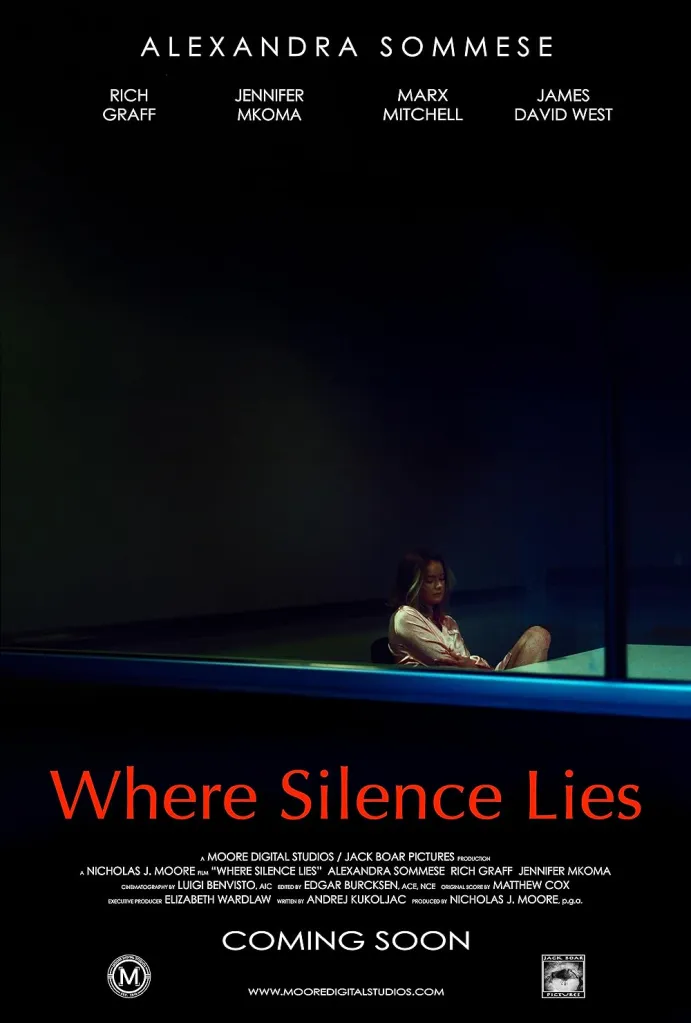
The film follows Audrey, the sole survivor of a brutal home invasion that leaves the powerful Bouchard family dead. She should be the key to solving the case. Instead, she becomes its biggest problem.
Detectives Ramos and Collins, played by Rich Graff and Jennifer Mkoma, bring her into an overnight interrogation room under mounting pressure to secure answers before the situation spirals into a public crisis.
But Audrey’s account quickly begins to unravel. Details shift. Evidence doesn’t align. Her version of events changes the longer she speaks.
What starts as a routine interrogation gradually transforms into something far more unstable—as the investigators begin to question not just her story, but her identity.
A Single Location, Maximum Pressure
Set almost entirely within the confines of an interrogation room, Where Silence Lies leans into its minimalist structure to amplify tension. Every pause, contradiction, and glance becomes significant. The lack of movement and changing environments forces the audience to focus on performance and dialogue, creating a slow-building sense of unease.
The approach places the film alongside contained thrillers like Exam and The Interview, while pushing further into themes of identity manipulation and psychological instability.
Without revealing its full truth, the film builds toward a central twist that reframes everything that comes before it. The “survivor” may not be who she claims to be. As the interrogation intensifies, the narrative shifts from a search for answers into a confrontation with a fractured reality—where truth becomes increasingly difficult to define.
Written by Andrej Kukoljac and produced by Nicholas J. Moore, the film was designed as a contained, performance-driven project from the outset.
Shot over six days in a real facility, the production relies on tight framing, controlled lighting, and escalating psychological pressure rather than traditional action or visual spectacle. This stripped-down approach allows the performances—and the shifting dynamics within the interrogation—to carry the film.
Final Thoughts
Where Silence Lies positions itself as a psychological thriller focused less on what happened and more on how truth is constructed—and distorted—under pressure. By confining the story to a single room and centering it on an unreliable narrative, the film creates a tense, unsettling experience that lingers beyond its final moments.
The film will have a limited theatre run as it’s waiting for distribution deals. You can purchase the tickets here!


‘Werwulf’ – Robert Eggers’ Haunting New Werewolf Poster Is Absolutely Stunning

‘The Conjuring: First Communion’ Adds Three New Actors to Ed & Lorraine Warren Prequel

Madeline Brewer, Emory Cohen and Nicholas Alexander Chavez Join Parker Finn’s Horror Movie ‘Possession’

Larry Fessenden Leads a Twisted Cult in Disturbing ‘Blood Shine’ Trailer

Christopher Landon to Direct Horror Movie Adaptation of Grady Hendrix’s ‘The Final Girl Support Group’

More than the Wolf Man: The Other Werewolves of Horror’s Golden Age

Joe Wright to Direct Post-Apocalyptic Thriller ‘Juice’ Adaptation

She Wakes Up Bound Inside a Car Trunk – Does She Deserve to Die?

A Mysterious Alien Force Invades in ‘Our Effed Up World’ Teaser

Exclusive ‘Hellcat’ Trailer Teases a Brutal Race Against Infection
Larry Fessenden Leads a Twisted Cult in Disturbing ‘Blood Shine’ Trailer

‘Fall 2: Deadpoint’ Trailer Takes the Terror 5,000 Feet Above Thailand

Josh Hartnett Faces a Deadly Sea Creature in ‘Below’ Teaser

Mike Flanagan’s ‘Carrie’ Teaser Introduces a New Nightmare
