
Dead Time with Scotty
Dead Time with Scotty, Story #7: The Global Swarm

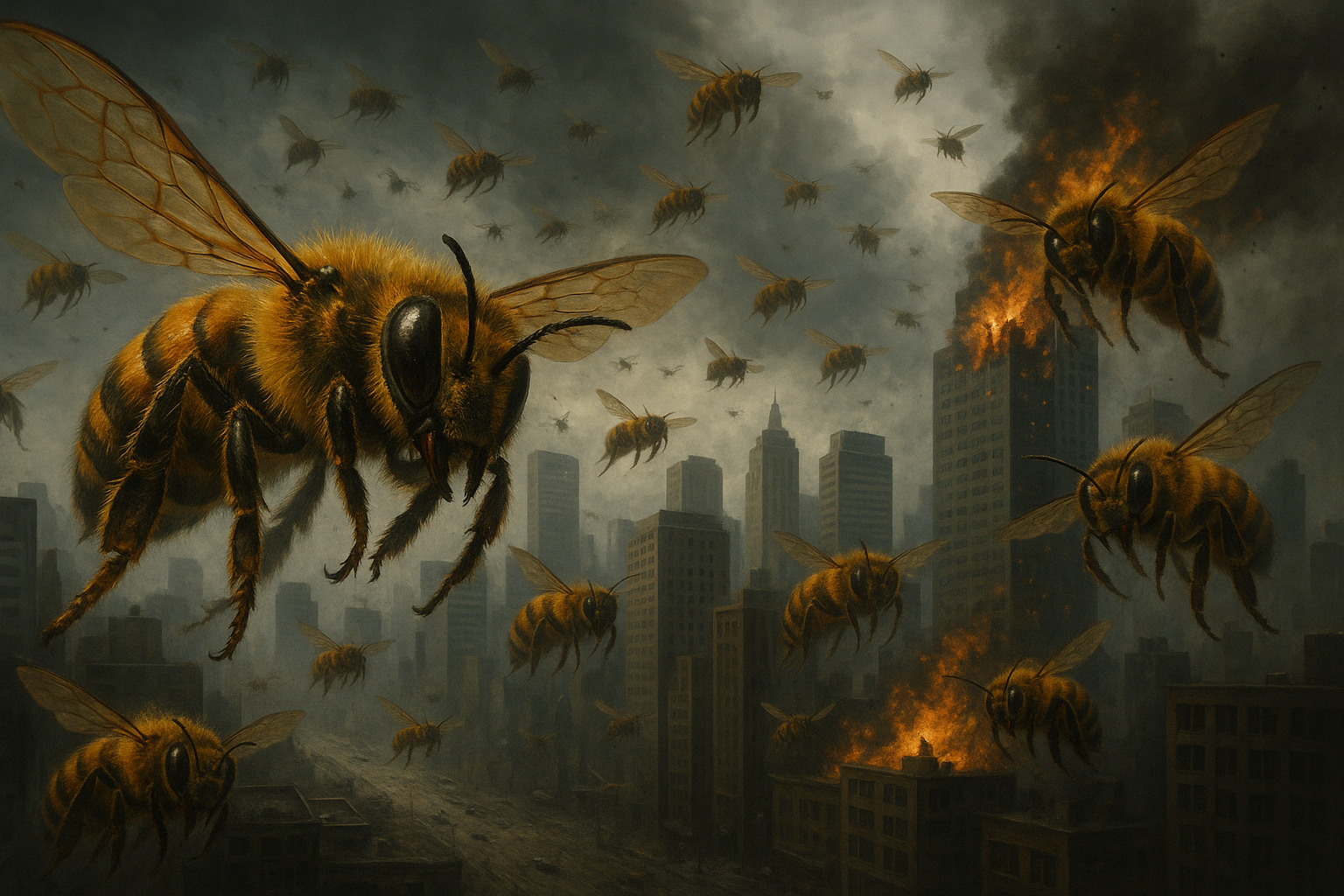
The first attack happened on a warm spring afternoon in Madrid.
Without warning, thousands of bees descended upon the Puerta del Sol. Tourists screamed. Locals ran for cover. What was initially dismissed as an aggressive hive turned deadly within minutes. Paramedics pulled stung bodies from the streets—each corpse puffed and blistered, veins turned black from some unknown venom.
By nightfall, Madrid was under lockdown. But it was only the beginning.
From Berlin to Paris, London to Budapest, and as far as Sydney and Tokyo, the same horrific events unfolded. Each swarm attacked with ruthless coordination, targeting populated areas, hospitals, even embassies. The media dubbed them “Black Darts,” for their sleek, unusually dark bodies and lightning-fast strikes.
But amid the chaos, three siblings—Jackson, Peter, and Samantha Szatkowski—were already piecing together a solution.
All three worked in different branches of science: Jackson, the eldest, was an entomologist with the European Center for Insect Studies in Berlin; Peter, a mechanical engineer based in London, specialized in drone defense systems; and Samantha, the youngest, was a biochemist at a private lab in Washington D.C., studying neurotoxins.
As the attacks intensified, they reunited at a classified World Health Organization safe house in Geneva. Footage from each city revealed a chilling pattern—the bees responded to frequency bursts, changed flight patterns in unison, and attacked infrastructure in a militaristic fashion. These were no ordinary insects.
“They’re being controlled,” Jackson muttered, watching the footage. “No species behaves like this without some kind of central intelligence.”
Peter leaned forward. “Not just controlled—enhanced. Look at the exoskeletons. Those aren’t natural.”
Samantha pulled up a toxin report. “The venom contains synthetic proteins. Someone engineered them.”
The pieces clicked. Somewhere, someone had turned bees into biomechanical weapons.
With global travel paralyzed and cities crumbling, the trio went underground, developing a two-part plan: First, isolate the control frequency used to command the swarms. Second, unleash a neutralizing signal strong enough to disrupt their coordination.
Peter constructed a portable emitter, a drone-based sonic disrupter with high-frequency resonance. Samantha synthesized a repellent enzyme that mimicked queen bee pheromones, intended to scatter hive behavior. Jackson, having identified the signal hub’s likely origin—an abandoned Soviet satellite in low orbit—coordinated with NASA and JAXA to deploy their countermeasure through Earth’s upper atmosphere.
The mission launched from Tokyo. The world watched from bunkers, shelters, and flickering television screens as the Szatkowskis climbed aboard the retrofitted weather plane named the Behemoth Of Light and Time, otherwise known as BOLT. With Jackson navigating, Peter manning the emitter, and Samantha injecting enzyme vials into the dispersal unit, they ascended toward the troposphere.
At 39,000 feet, they released the payload.
The signal burst echoed globally—inaudible to humans but thunderous to the bees. Across the world, swarms paused mid-flight. They twitched, spun in confusion, and then—collapsed. From Sydney to Budapest, black clouds of dead bees fell like dark rain.
When BOLT landed, silence reigned.
For the first time in weeks, birds chirped again over the Eiffel Tower. Children emerged from subway shelters in Washington. People wept in Trafalgar Square and sang in the streets of Berlin. The war was over.
The Szatkowski siblings stood on the runway, exhausted but victorious. No medals awaited them—just the gratitude of a planet saved from an apocalypse wearing wings and a stinger.












‘Hokum’: New Image Reveals Adam Scott in Horror Film from ‘Oddity’ Director

‘Blood’ Teaser Trailer Drops After Viral TikTok Campaign Hits 10M+ Views

Mike Flanagan’s ‘The Exorcist’ Adds John Leguizamo to the Cast

‘The Cure’ Trailer Reveals New Sci-Fi Horror Starring David Dastmalchian

Radio Silence Says ‘The Mummy 4’ Will Deliver “Heart and Character”

Uma Thurman Faces Killer Ballerinas in ‘Pretty Lethal’

Lee Cronin’s ‘The Mummy’ Trailer Drenches You in Death and Terror

Urban Exploration Turns Deadly in ‘Do Not Enter’ This March

‘Bodycam’ Trailer: Shudder’s Found Footage Horror Feels Like a Full-Length ‘V/H/S’ Nightmare

Don’t Blink: ‘Exit 8’ Trailer Delivers Neon’s Surreal Horror Nightmare
‘Blood’ Teaser Trailer Drops After Viral TikTok Campaign Hits 10M+ Views
‘The Cure’ Trailer Reveals New Sci-Fi Horror Starring David Dastmalchian

‘In a Violent Nature 2’ Trailer: Johnny Targets a Summer Camp in Brutal Slasher Sequel

‘Backrooms’ Movie Teaser from A24 Promises Liminal Horror in May 2026