
Dead Time with Scotty
Dead Time with Scotty, Story #5: Stings of the Tide

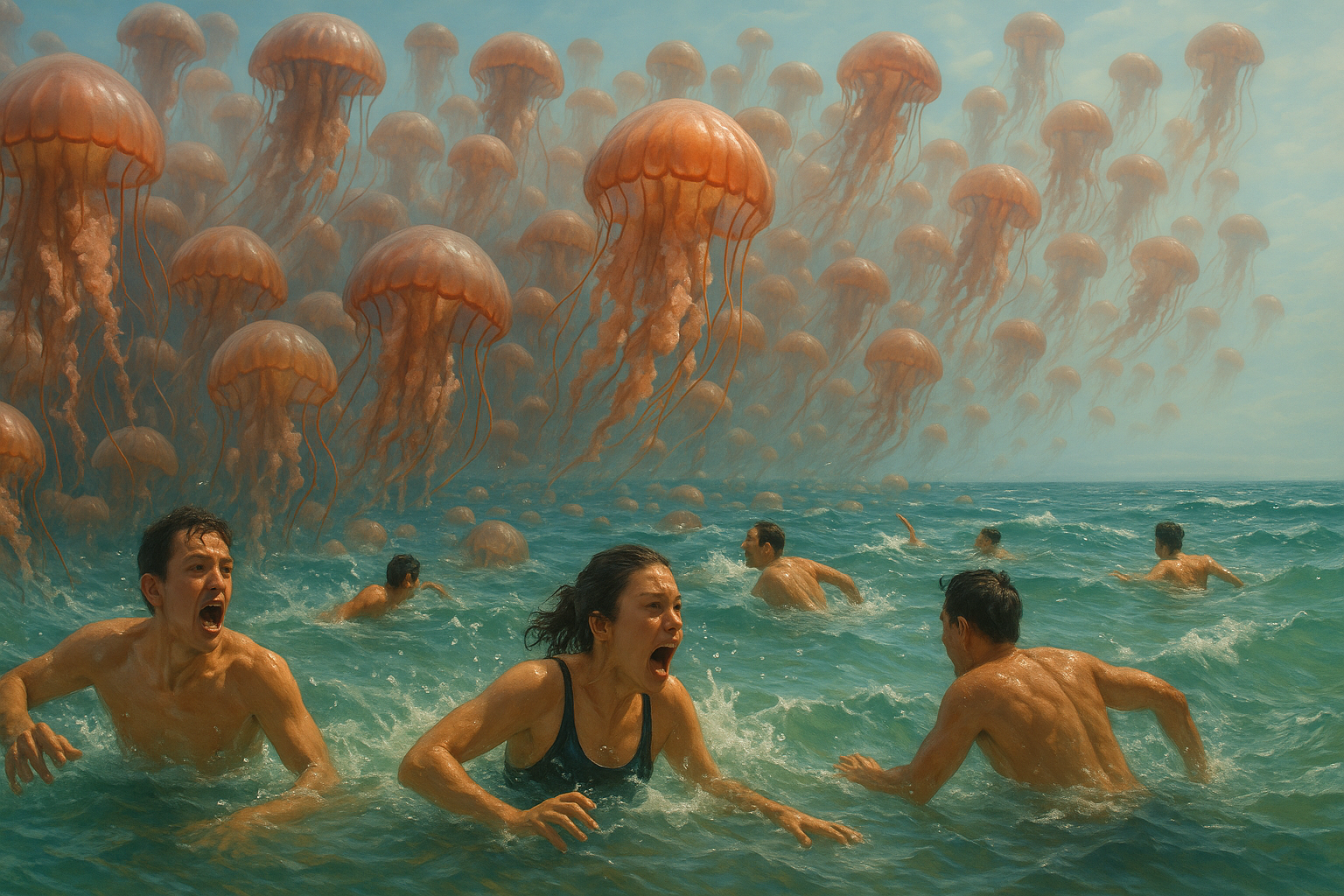
The sun blazed overhead as waves lapped rhythmically against the shore of Solara Beach. It was the peak of summer. Umbrellas dotted the golden sands, radios played upbeat tunes, and laughter echoed across the shoreline. Kids built sandcastles, couples splashed in the surf, and families cooled off in the shimmering blue water.
Up in the tall red lifeguard chair, Jordan Malenko scanned the scene with practiced vigilance. His partner, Taylor Petrole, leaned against the tower’s post, sipping water and cracking jokes about sunscreen and sea gulls.
“Place is packed,” Jordan muttered, his eyes behind polarized shades.
“Yeah, and not a riptide in sight,” Taylor replied. “Might actually be a boring day.”
It wasn’t.
At first, it was just one scream. A woman flailing in waist-deep water, slapping at something under the surface. Then another shout, further down the beach. Then dozens more. Panic erupted as swimmers scrambled toward the shore, many of them shrieking in pain. Blood mixed with saltwater. Red welts blistered on arms, necks, legs. One man collapsed in the shallows, convulsing.
Jordan grabbed the rescue board and sprinted toward the surf. “Go left! I’ll take the center!”
Taylor nodded, plunging into the water with his float. “Let’s move!”
What met them beneath the waves was horror: a horde of jellyfish, at least fifty or more, their translucent bells pulsing rhythmically, their tentacles trailing like living whips. But these weren’t ordinary jellyfish—they were massive. Each one the size of a beach ball, and their stings weren’t just painful—they were aggressive, deliberate. They wrapped around swimmers’ throats, coiled around limbs, dragging them down.
“Medusas,” Jordan shouted to Taylor, referencing the rare and venomous species known for territorial swarms. “This is organized!”
Jordan reached a teenager tangled in tendrils. With a dive knife from his belt, he sliced the jellyfish away, pulling the boy to the board. He turned to see Taylor fighting off three of the creatures, stabbing wildly, freeing a pair of children.
They worked like demons—cutting, pulling, pushing terrified swimmers to safety. Radios crackled as other lifeguards and paramedics joined in, but Jordan and Taylor were the first, the closest, and the most exposed.
Then Taylor saw a father still stuck in deeper water, unconscious, floating face-down in a jellyfish nest.
Without hesitation, he dove.
Jordan shouted after him, “Taylor, wait!”
But Taylor was already under.
He reached the man, hacked through the writhing web of stinging tentacles, and pushed him upward toward a nearby lifeboat. But in the effort, he hesitated too long. One jellyfish wrapped around his leg. Another seized his arm. A third latched onto his throat.
Jordan swam toward him, heart hammering, but it was too late. Taylor broke the surface for a second, gasped, and smiled faintly at his partner.
Then he sank beneath the green-tinged waves.
By the time Jordan reached him, Taylor’s body was limp.
Later that evening, the beach was deserted, cordoned off by emergency crews. Marine biologists speculated it was a freak bloom—temperature shifts, current changes, perhaps even sonar disruptions. Whatever it was, the swarm dispersed as quickly as it had come. None of the jellyfish remained by nightfall.
Jordan stood alone at the edge of the water, the sun dipping low and red across the horizon. Behind him, the people Taylor helped save sat quietly, bandaged and alive. The children Taylor had pulled from death’s grip clutched their parents, safe. A beach once filled with chaos now whispered with gratitude and mourning.
A memorial buoy was placed offshore the next day, with a plaque that read:
“In memory of Taylor Petrole—lifeguard, hero, brother of the sea.
He gave everything to keep us afloat.”
The beach reopened a week later. People returned. Children laughed. Life went on.
But every time the tide rolled in, Jordan swore he could hear Taylor’s voice in the waves—laughing, fearless, watching over them still.












‘Hokum’: New Image Reveals Adam Scott in Horror Film from ‘Oddity’ Director

‘Blood’ Teaser Trailer Drops After Viral TikTok Campaign Hits 10M+ Views

Mike Flanagan’s ‘The Exorcist’ Adds John Leguizamo to the Cast

‘The Cure’ Trailer Reveals New Sci-Fi Horror Starring David Dastmalchian

Radio Silence Says ‘The Mummy 4’ Will Deliver “Heart and Character”

Uma Thurman Faces Killer Ballerinas in ‘Pretty Lethal’

Lee Cronin’s ‘The Mummy’ Trailer Drenches You in Death and Terror

Urban Exploration Turns Deadly in ‘Do Not Enter’ This March

‘Bodycam’ Trailer: Shudder’s Found Footage Horror Feels Like a Full-Length ‘V/H/S’ Nightmare

Don’t Blink: ‘Exit 8’ Trailer Delivers Neon’s Surreal Horror Nightmare
‘Blood’ Teaser Trailer Drops After Viral TikTok Campaign Hits 10M+ Views
‘The Cure’ Trailer Reveals New Sci-Fi Horror Starring David Dastmalchian

‘In a Violent Nature 2’ Trailer: Johnny Targets a Summer Camp in Brutal Slasher Sequel

‘Backrooms’ Movie Teaser from A24 Promises Liminal Horror in May 2026